The Report Nobody Wrote
By Ascher Studios
A company, read back to itself.
I watched someone spend a Friday building the weekly roundup.
You know the one — the “here’s what everyone’s been up to” update. To write it, they had to go read everything: the updates from each team, the notes, the decisions made in three different threads, the docs someone quietly finished, the thing that changed on Tuesday that nobody announced. They pinged a few people to fill the gaps. They stitched it all into a summary short enough that a busy person might actually read it. Then they sent it out.
It wasn’t hard. That’s the part that gets to me — same as the person copying an order across two screens, one line at a time. Every step was something a careful person could do without thinking, which is exactly why they shouldn’t have been the one doing it. They read what already happened and wrote it down somewhere else. It ate their afternoon. It was a little out of date the moment it went out. And — the quiet tragedy — half the org skimmed the subject line and moved on.
Meanwhile the real knowledge kept piling up faster than any one person could read it.
It’s the same shape again. A capable person parked in the middle — this time standing between everything that happened across the org and the people who need to know it, doing the reading and the writing-up by hand.
This series has spent months on a single idea. An organization that writes its context down — its brain, the plain-language account of who it is, how its systems fit, what it’s building and why — and then points generic agents at that context, with humans kept at the two ends. Write it down once, the argument went, and the AI stops needing you to be the middleman. But there’s an obvious next question hiding in there, and I don’t think I’ve said it out loud yet: once you’ve written all that down — who reads it? The brain fills up with everything that happened. Nobody has time to read the whole thing.
Here’s the turn, and it’s the whole point of this post: the same AI that reads the brain to do the work can read the brain to tell you what’s in it.
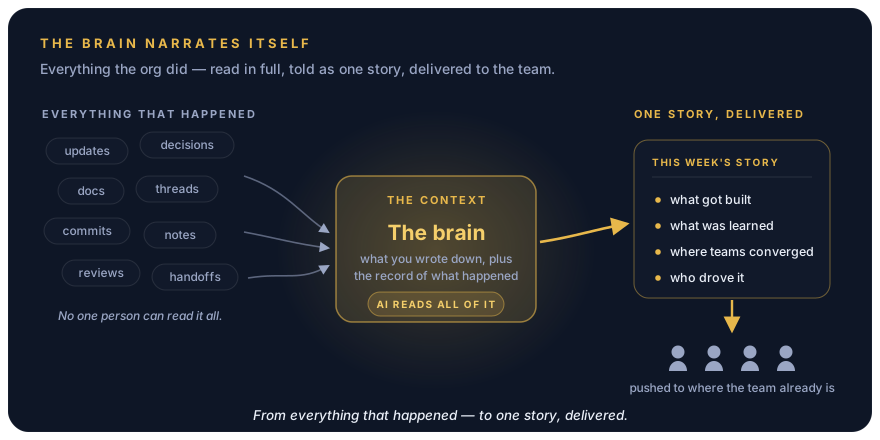
The report stops being something a person assembles by hand. It becomes the brain narrating itself — reading across everything that happened and telling the story back to the people who lived it. Not a person going out to gather the news. The place the news already lives, learning to speak.
Let me be concrete about what that changes.
It reads everything. No person can keep up with a whole organization’s activity — you sample it, you ask around, you catch what’s loud and miss what’s quiet. An AI that lives in the brain reads all of it, every cycle. The full coverage a hand-written roundup only ever pretended to have.
It tells a story. And here’s the distinction I’d hold onto: this is a narrative of what happened, not a dashboard of numbers. The hard part of a roundup was never collecting the updates — it was making sense of them, turning a heap of raw progress into something a person could absorb: what got built, what was learned, where it’s heading. That’s the part the machine does now. Not a page of charts, and not a wall of everyone’s notes pasted together — the narrative underneath them.
It sees where things converge. This is the one a human report almost never gets. Reading across every team at once, the AI catches the connections no single team can see from inside its own lane — two groups quietly solving the same problem, work on one side that lines up with work on the other, a gap between them nobody noticed because nobody was looking at both. That see-across-everything view only comes from reading the whole thing, not one slice of it.
It recognizes people without ranking them. Reading everyone’s work, it can name the people behind it and give them credit for what they shipped — and it deliberately stops there. It doesn’t turn that into a scoreboard of who did the most. Something like this could trivially become a machine for ranking and watching people; choosing to recognize instead of rank is a line I’d draw on purpose, so the thing stays something that celebrates the work rather than polices the people.
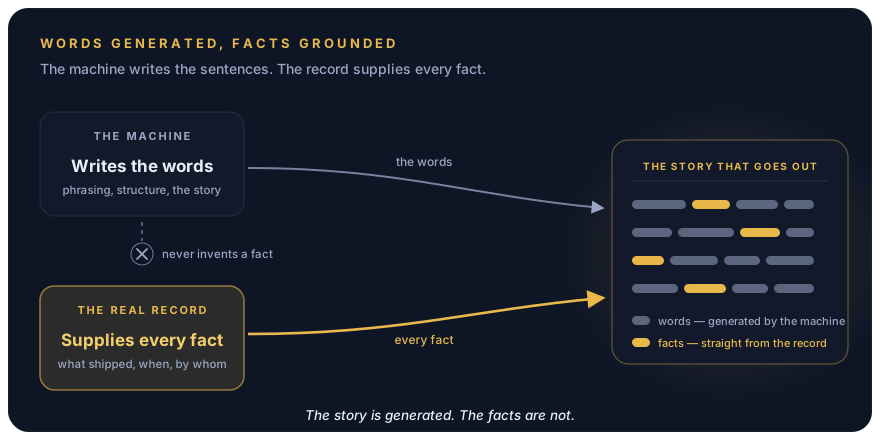
It comes to you, and it can’t make it up. The report is pushed to the team where they already are — a message that lands in the flow of the day, not a page nobody reopens. And here’s the part I’d underline: the machine writes the words, but every fact comes straight from the real record of what happened. It narrates; it does not invent. That’s the whole line between a trustworthy account and a confident fabrication — and it’s the design, not a nice feature bolted on the side.
I want to say the honest part out loud, because a post about a company that narrates itself is exactly where the hype sneaks in.
This is not “fire the person who writes the update,” and it is not a machine that runs the organization. It does the roughly 80% that’s mechanical — the reading, the sorting, the first-draft write-up nobody should be spending a capable person’s week on. The trust-bearing 20% stays human: what the story actually means, what to do about it, what’s worth acting on and what’s worth celebrating. A person reads the story before it goes out. And it earns the right to run on its own schedule only after what it pulls together proves out across reviewed cycles. The grounding in real facts and the human read aren’t safety extras bolted on — they’re how it earns that right. Real, compounding leverage on the mechanical work. Not autonomy that runs loose.
Which brings me back to the person who used to lose every Friday to the roundup. The point was never speed. It was to stop spending a capable person’s best hours transcribing what already happened — and to give them back the part that was always theirs: deciding what matters and what to do about it. And to give the team the thing they never actually got — a true, current picture of what they’re all building together, instead of a summary half of them didn’t finish.
That’s the quiet payoff of writing your context down. You build the brain — and then it can tell you its own story. The same move this studio is built around: the mechanical middle to the machine, the human ends kept.
The truest account of the week turns out to be the one nobody wrote.