The Blank Slate
By Ascher Studios
The setup that ends the reset.
I keep watching people meet the same wall, and it’s such a quiet one that most of them don’t notice they’ve hit it.
They open the most capable tool any of us has ever had, and they start by explaining themselves. Who they are. What they do. What the project is, what the constraints are, which names mean what, what they’re actually trying to get done. They type it out — carefully, because it matters — and they get their answer. And the next day they open the same tool and type most of it again. And the day after that, again. Every conversation starts from nothing. Every session, the introductions.
It isn’t hard. That’s the part that gets to me — same as the person copying an order across two screens, one line at a time. Nothing about re-introducing yourself is difficult. It’s just waste, the pure kind: a capable person spending the first ten minutes of every good idea rebuilding the ground the last conversation already stood on. You wouldn’t brief a new colleague from zero every single morning and then act surprised the work stays shallow. But that’s the deal most people have quietly accepted with AI — a brilliant stranger who forgets you the moment you close the tab.
Here’s the turn, and it’s the whole point of this post: the blank slate is the problem, not the model. The thing between a person and real leverage was never how smart the AI is — it’s that it starts every day not knowing them, and they’ve accepted that as just how it works.
It isn’t how it has to work. I know, because I did the cheap version on myself first.
I wrote my own context down. Not a clever prompt — the plain stuff. My systems, my goals, the logic behind how I work, the names, the why. I put it in one place the AI reads at the start of every session, and then I wired that up to my actual tools, and I let the AI keep the memory current itself — hold on to what mattered, set down what didn’t. The reset just… stopped. One person’s setup, not a benchmark — but it changed how I work. I no longer had to be the thing standing between the AI and the reality of my day. It could pick up where we left off, explore on its own, test its own assumptions, and keep what it learned. It stopped being a stranger I re-met each morning and started being something closer to an agentic version of me — pointed at my world, running on my context, doing the parts I’d rather not.
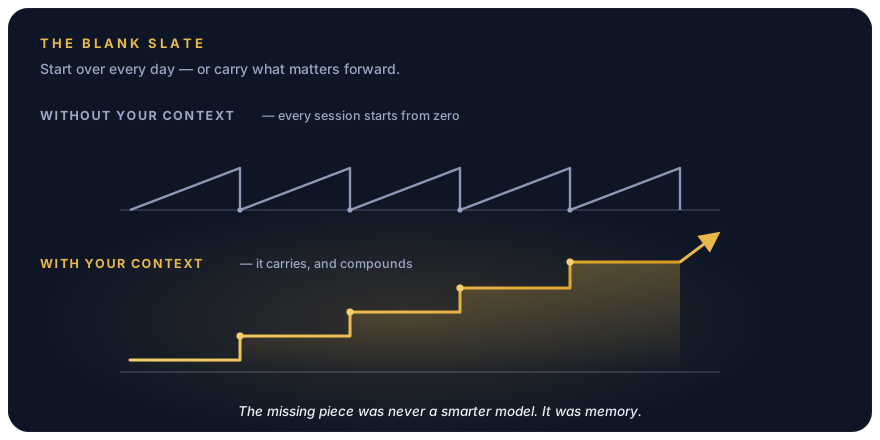
I want to say plainly what that setup actually is, because the words matter and people oversell this constantly. The word I’d gently retire here is brain. Nobody hands you a finished brain — nobody builds you one. What you build is the infrastructure for one: a place your context lives. Then you give directives to agentic AIs, and they keep your key information in a shared, brain-like memory they maintain as they work. The memory is a metaphor for the storage, not a mind in a box. That memory, wired to your tools, is what unlocks the real thing worth naming — an agentic version of you. The AI stays generic. Your context is what makes it yours.
And the core move here isn’t code. It’s writing down what you already know — who you are, what you’re trying to do, how your world fits together, the names and reasons you’d otherwise re-explain to every new person in their first week. That’s not engineering. The AI does the technical part.
Here’s the leap I think most people haven’t taken yet, so let me walk it gently. Almost everyone uses AI in one mode: Ask. You pose a question, it answers, you close the tab. That’s a search box with better manners — and it’s most of the world’s entire relationship with the most capable tool of our lifetime. But it can do more than answer now. It can Act — reach into your systems and actually do the work, not just describe it. And the far end, the one that changes everything, is when it can act like you — carry your context, your judgment, your way of doing things, so what comes back is what you would have done. Ask, to Act, to act like you. Almost everyone is idling in first gear on a machine that has three.
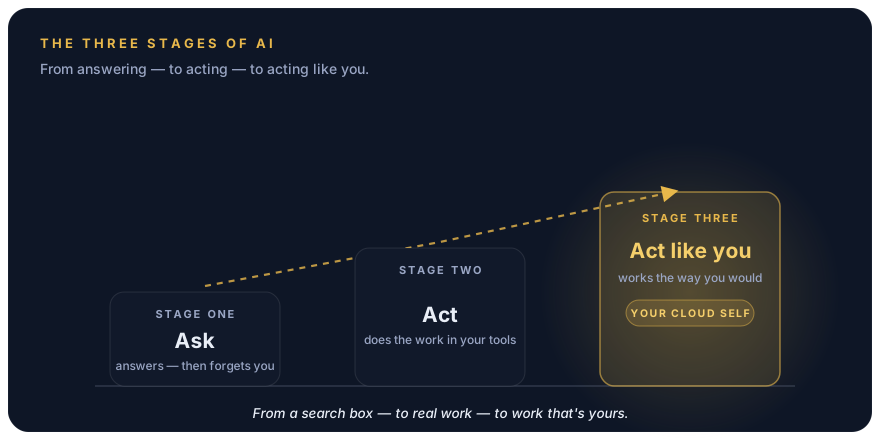
Two words of honesty before anyone hears “acts like me” and pictures a machine running loose. Agentic does not mean unsupervised. You stay at the ends — directing at the front, judging at the finish. The AI runs the middle; you keep the vision and the verdict. You don’t lose control — you move to where control actually matters. More capability, more of you at the parts that need you — not less.
And the version worth having is one you own. Not a bespoke system you rent, not a secret app you log into and hope — your context, your tools, your judgment, assembled into a thing that’s genuinely yours and living in your account rather than somebody else’s. If the person who set it up with you vanished tomorrow, you’d still have it. That ownership is the whole point — a cloud self you don’t own isn’t a cloud self, it’s just another subscription.
I know how three worries sound from the other side of this, because they’re reasonable. I’m not technical enough for this. So I’d have to buy some bespoke system — a black box I don’t understand. Doesn’t handing my work to AI mean handing over control? And here’s the honest part: you are trusting AI with more of your work — that part is not a misunderstanding. Setting this up the first time does take a bit of doing. And the instinct that a thing this useful must be complicated and proprietary is a reasonable guess about how the world usually works. But it’s the reverse: a plain-language account of your context, wired to your tools, kept in a memory you can read. It’s the least mysterious software you’ll own — because the most important part of it is written in sentences you’d recognize as your own.
And I want to be honest about the ceiling, because this is the easy part to oversell and I’d rather you trust the next thing I tell you. This is not magic, and it is not hands-off. It does not run your life while you sleep. What it does is take the roughly 80% that’s shoveling — the re-explaining, the fetching, the mechanical middle nobody should be paying a capable person to do — and hand it to agents that already know your context. The trust-bearing 20% stays yours: every message that goes out under your name, every dollar spent, every published decision, every irreversible call. The leverage is real, and it compounds — but anyone who tells you otherwise is selling the curve, not the setup.
Which brings me back to the person opening a fresh chat and typing their whole life into it again before they can get a single useful thing back. The point of ending the blank slate was never speed for its own sake. It was to stop making capable people spend their best hours reintroducing themselves to a tool that should already know them — and to give them back the part that was always theirs. The judgment. The care. The taste. The relationships. Take the reintroductions away, take the shoveling away, and what’s left is the part you’d want a real person doing in the first place.
That’s the one I built for myself. Now I get to build it with other people. One at a time, the same way — their context, their tools, their call.