It Was Never the Data
By Ascher Studios
The same shift, scaled up.
I watched someone open an email with an order in it. The order was an attachment — a PDF, then later a spreadsheet, then once an image of a printout. They opened it, read it, and started typing it into another system, one line at a time. Customer name, checked by eye. Item, matched by hand. Quantity, copied across. Then the next line. Then the next.
It wasn’t hard. That was the part that got to me. Every step was something a careful person could do without thinking, and that’s exactly why they shouldn’t have been the one doing it. They were reading numbers off one screen and putting them into another, all morning, the way you’d shovel a driveway you’d just have to shovel again tomorrow.
None of it needed a person. And a person was doing all of it.
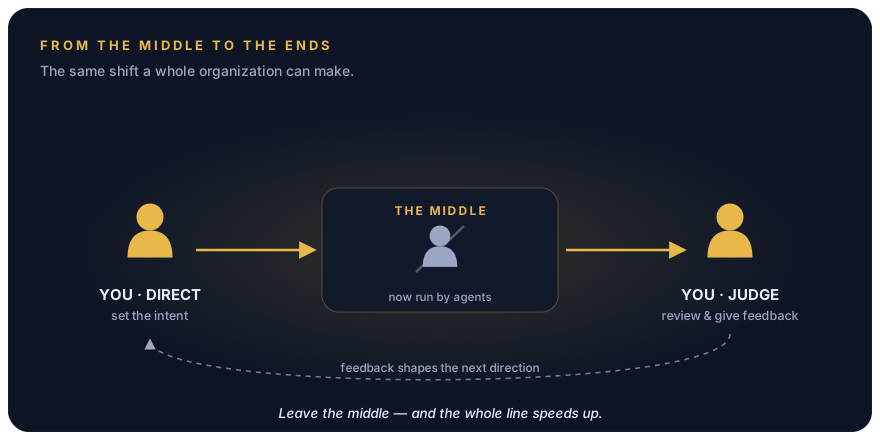
This isn’t one job, or one company. It’s a shape I keep seeing — capable people parked in the middle of a workflow, copying, pasting, re-explaining, rebuilding knowledge that already lived somewhere. I wrote once about leaving that middle as a single developer — moving out to the bookends, visionary at the front and reviewer at the end. This is the same move, scaled up. An organization can be the human in the middle too — a whole company spending its best people bridging gaps that shouldn’t need a bridge, and calling it operations.
When a leader finally wants AI to take that middle, two instincts usually get in the way. The first is to wait: first we have to clean up all our data. And I want to concede this hard, because it’s sincere and it’s not wrong — clean data is real, it matters, and it’s worth doing. What I’m arguing against is treating a perfect data foundation as a gate you have to wait behind before AI can help at all. That cleanup never quite finishes — there’s always another system, another exception, another year of it — so the value keeps living one quarter past the horizon while the team in the middle keeps shoveling.
The second instinct is the opposite mistake: believing the answer is some special, bespoke, fine-tuned model you buy or train. It isn’t. And the thing that demystifies all of it is a single idea.
Context is the one piece that transforms all the others.
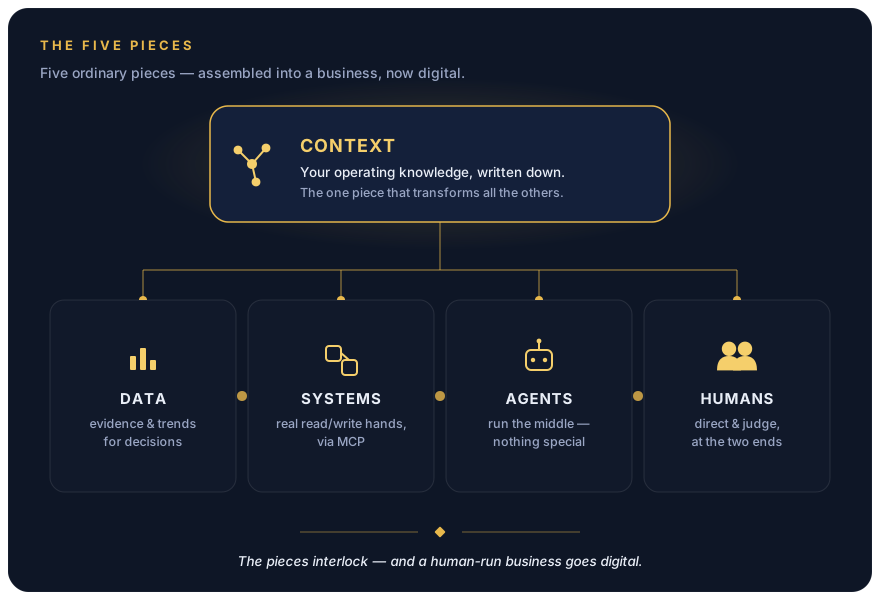
Here’s the picture I keep coming back to. Take a living, human-run business and imagine it going digital — not bought wholesale, but assembled from a few pieces you already have. The five pieces of the puzzle:
- The brain. All the operating knowledge that lives in people’s heads and hallway conversations — who you are, how your systems fit, what you’re trying to do and why — written down into one place the AI reads first. That’s the context: the plain-language thing you’d otherwise re-explain to every new hire in their first week.
- The data. Not a static dashboard to glance at, but something an agent can actually reach into, to spot trends and back a decision with evidence instead of a hunch. Context is what makes those numbers mean something; a column of figures is noise until something tells the AI what it represents and why you’d care.
- The systems. The same systems you already run. The difference is that instead of a person clicking through them, there’s a shared open standard — MCP, a common protocol for giving an AI safe hands to read and write — that makes reaching into those tools trivial. Common infrastructure, not a proprietary bet.
- The workers in the middle. They become agents. And this is the part people most want to be special, so I’ll say it plainly: the agents are not special. They aren’t fine-tuned to your business. They’re generic — simply told to operate off your context and to use your data and your systems. That’s the corollary of the one idea: because the context carries everything, the model underneath doesn’t have to be special. You don’t need a bespoke model; you need your context wired to the rest.
- The humans. They move to the two ends — directing at the front, where you decide what’s even worth doing, and judging at the end, where you review, apply taste, and make the calls that carry trust.
Leverage follows from there, almost by subtraction — not a speed-up that runs away, but a steadier, compounding one. Once the brain, the data, the systems, and the agents are in place, there is only technology between the human directing at the front and the human judging at the end — though a person still stands at each end, on every send, every dollar, every irreversible call. Nothing in the interior is waiting on a person to be the bridge — the judgment calls still are.
You don’t build this as one big door you finally walk through. You start the pieces now, in parallel — centralize the context, wire it to the data, connect the systems, point agents at the middle — and you prove it in the work. Small. One workflow at a time. Not boil the ocean.
I know it works because I did the cheap version on myself first. I wrote my own context down — my systems, my goals, the logic, the names, the why — into one place the AI reads at the start of every session. The change was immediate: I no longer had to be the middleware between the AI and the reality of my work. Before, I re-explained everything every single time. After, the AI could explore the environment itself, read the structure, write the queries, test its own assumptions, and keep what it learned. And it compounds — each new agent inherits that same context from day one instead of being briefed from scratch.
The part that made it real was watching it happen. I pointed an AI at a genuinely messy data environment — hundreds of tables, no documentation, inconsistent naming — and with the context in hand it explored the tables on its own, inspected the columns, and reasoned its way through with almost no hand-holding. One environment, not a benchmark — but it landed. The mess didn’t stop it, because the missing piece was never the data. It was the context.
I want to say the honest part out loud, because it’s the easy part to oversell: this isn’t magic, and it isn’t hands-off. Agents do the roughly 80% nobody should pay their best people to do; the trust-bearing 20% stays human — every send, every dollar, every published decision, every irreversible act is a person’s call. The leverage is real and it compounds, but it’s a flatter, cheaper slope on the interior work — not a machine that runs itself.
Which brings me back to the person re-typing an order line by line. The point of taking the organization out of the middle was never speed for its own sake. It was to give that person back the part that was always theirs — the judgment, the care, the exceptions, the relationships, the strategy. Take the shoveling away and what’s left is the part you’d hire them for in the first place.
I’m still learning it in the open, scaled up now from me to the businesses I see around me. One piece of the puzzle at a time.