2026: The Brain
By Ascher Studios
The year the brain went plural.
I want to start with a small moment, because the small ones are where I notice things first.
Someone I know sat down to their AI one morning this year and started, out of habit, to explain themselves — who they are, what they’re working on, the usual opening ten minutes — and then stopped. Because it already knew. No fanfare, no demo, just a quiet oh, right — we don’t do that part anymore, and then straight into the actual work. I’ve watched a version of that land on the same face every time — a handful of people, not a survey, but it’s a face I recognize, because it’s the one I made when the reset stopped for me.
It’s the same person, really, that this journal keeps circling back to. The one copying an order across two screens, one line at a time. The one opening a fresh chat and typing their whole life into it again before they can get a single useful thing back. This is that person on the morning the typing stopped being necessary — and this year, for a growing number of people, it quietly did. Which moves the question I care about from whether the reset ends to who owns the memory when it does.
One arc, three distances
I’ve been telling one story from three distances, and it’s worth pulling the thread tight before I go anywhere new, because everything after this depends on it.
From the desk, it looked like a developer moving out of the middle of the workflow to the two bookends — visionary at the front, reviewer at the end — and finding that leaving the middle didn’t slow the engine down, it sped it up. From the org, it was the same move scaled up: a whole company can be the human in the middle too, and the thing that takes it out isn’t a magic model or a multi-year data cleanup — it’s writing your own context down, the cheap piece everyone skips. From the person, it was the blank slate: most people use the most capable tool of our lifetime like a search box that forgets them overnight, and the fix was never a smarter model. It was memory.
The spine under all three is one sentence: the thing between a person and real leverage was never how smart the AI is — it’s that it starts every day not knowing them. Write the context down, wire it to the tools, let the AI keep the memory itself, and the reset ends. Ask, to Act, to act like you — most people still idling in first gear on a machine that has three.
Here’s what changed this year, and it’s the reason I’m not just restating those posts. That idea stopped being something I had to argue for.
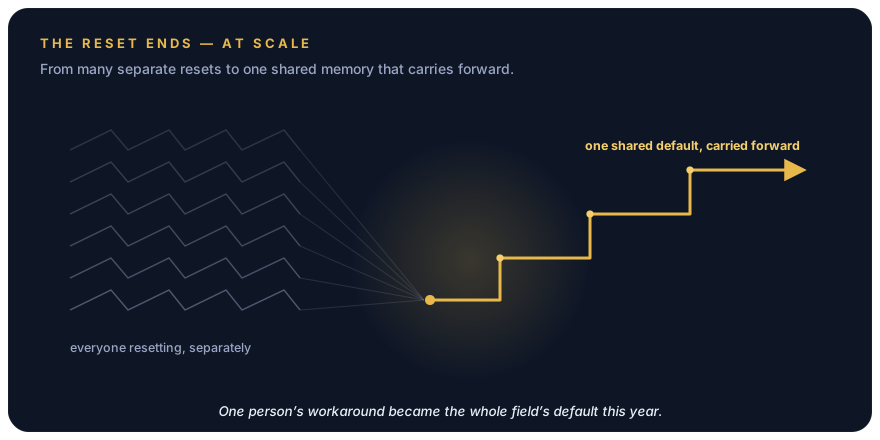
For a while, persistent memory was my private workaround — the cheap version I ran on myself while the tools shipped without it. This year the tools stopped shipping without it. One after another, the major tools started building memory in: your context, held across sessions, read first. The thing I’d been quietly doing by hand became the headline feature the whole field reached for at once. Which is genuinely good news — the reset is ending for everyone, not just the people stubborn enough to hand-roll it.
But it moves the question. The question was never really whether the reset ends. It’s who owns the memory when it does.
Here’s the turn: capture is easy, permission isn’t
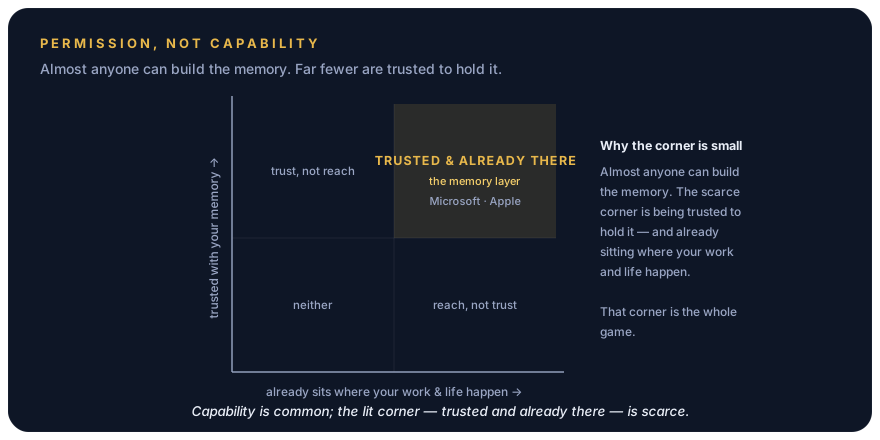
Here’s the turn, and it’s the whole point of this post: writing your context down is buildable by almost anyone — the recipe is plain, as the earlier posts kept insisting — so the scarce thing was never the capability. The scarce thing is being trusted to hold that memory, and already sitting where your work and your life actually happen. Permission, not capability.
If context is the keystone — the earlier posts’ whole argument — then whoever holds it holds the leverage. And it’s worth keeping the honest word: the brain is a metaphor for storage, a place your memory lives, not a mind in a box. Nobody hands you a finished brain. What everyone is now racing to own is that storage layer — the place your context sits, the memory the agents read before they do anything. So the fight of 2026 isn’t over who can build the memory. Almost anyone can. It’s over who gets to keep it — and the party best positioned to keep it is the one that already sits where you work, and already holds your trust.
Which raises the obvious next question, and it’s the one I actually want to put a stake in.
My bet: an enterprise brain and a personal one
So here’s my bet — and I want to flag it as a bet before I make it, because I’ve been wrong about the pace of this stuff before, and this is one person’s read of the board, not a forecast.
The trusted incumbents already embedded where the work and the life happen are best positioned to own the two memory layers. Not the party with the smartest model. The party that’s already there.
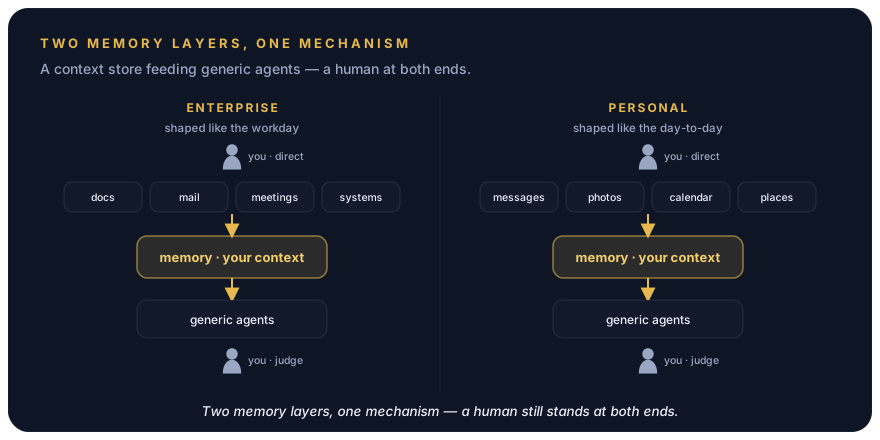
For the enterprise, that shape looks like Microsoft. Think about where a knowledge worker’s day already lives — the documents, the mail, the meetings, the chat, the identity you log in with, the systems the company already runs on. That’s a decade of accumulated position and, just as important, accumulated trust — the kind a security team has already signed off on. A memory layer there doesn’t have to be invented from nothing; it just has to be switched on next to where the work already is.
For the personal side, that shape looks like Apple. The device already in your pocket, the messages, the photos, the calendar, the quiet daily texture of a life — and a company whose whole brand promise is that the private stuff stays private. A personal brain is only worth having if you’d trust it with the parts of your life you don’t hand to anyone. The company that already holds that trust starts the race a long way ahead of a newcomer asking you to pour your life into it cold.
That’s the wager: an enterprise brain shaped like the place work already happens, a personal brain shaped like the place life already happens, each one a context store feeding generic agents, with a human still standing at the two ends of both.
And I put the counter-case next on purpose. I’d rather argue against my own bet in public than sell you a clean prediction I don’t fully believe.
The case against my own bet
Here’s the strongest version of the other side, and I want to give it real weight, because each piece could be the thing that proves me wrong.
Portability could dissolve the whole moat. If open standards win — if your memory becomes something you can pick up and carry between tools as easily as a file — then sitting where the work happens stops mattering. The incumbent’s advantage was always lock-in dressed as convenience. Make the memory truly portable by default and the giant’s position evaporates; you’d just take your context to whoever serves you best that year.
The deepest context is domain-specific. A generalist platform holds the shallow, universal layer — your mail, your calendar, your files. But the context that actually runs a business often lives deep inside a specialist’s world, in the particular shape of one industry’s work. A focused vendor can go deeper into their slice than any generalist ever will, and the memory that matters most might end up living there, not in the big flat platform.
Centralizing everyone’s memory raises the stakes of a single breach. The same trust that makes an incumbent strong is the thing one bad breach — or one overreach — can break for good. Put a person’s whole life, or a company’s whole operating brain, in one place, and you’ve built the highest-value target anyone’s ever built. Trust is slow to earn and instant to lose, and a memory layer is exactly the kind of thing regulators eventually decide can’t belong to one company at all.
And the winner might not be an incumbent at all. The board isn’t only the giants. A challenger who nails portability and trust at the same time — who makes owning your own memory the default rather than the hard path — could take it from underneath everyone I just named.
So here’s what would prove me wrong, plainly: if memory becomes truly portable by default, or if a breach or a regulator forces it open, the incumbent bet loses. The honest read is that the outcome is contested and layered — not one clean winner, and not settled this year. I’m putting a stake in the ground knowing the ground might move.
What survives whoever wins
But here’s the part I’m actually sure of, and it’s the reason none of this changes what the studio is building.
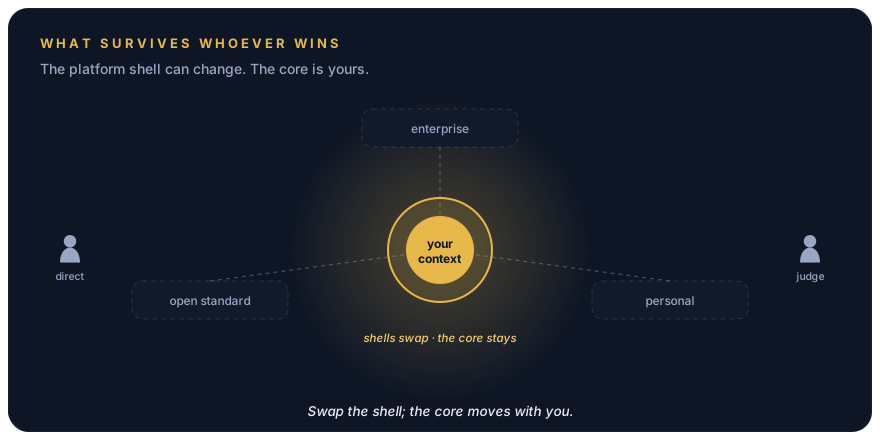
Whoever wins the platform, the value was always in the same two things this whole series has argued: your context, and generic agents pointed at it — with your judgment kept behind humans at the two ends. That’s true if Microsoft owns the enterprise brain and Apple owns the personal one. It’s true if open standards blow the whole thing open and there’s no owner at all. The context is the asset. The rest is interchangeable.
And I have to restate the ceiling once more, because a post about giant companies racing to hold your memory is exactly where the hype sneaks in. This is not a machine that runs itself. It’s sub-linear, compounding leverage — agents do the roughly 80% that’s shoveling, the re-explaining and the fetching and the mechanical middle; the trust-bearing 20% stays yours. Every message sent under your name, every dollar spent, every published decision, every irreversible call. Leverage that compounds, not autonomy that runs loose. Anyone selling you the second thing is selling the curve, not the setup.
Which is why the move that’s right regardless of who owns the memory is the same one it’s always been: own your own context, and keep it portable. In a year when everyone wants to hold your memory for you, holding your own is the position that never quietly turns into someone else’s subscription. That’s quietly the whole reason the studio built what it built, and I’ll leave it at that, because this isn’t the place for a pitch.
Which brings me back to the person whose morning already knew them. The reason to care who holds the brain — Microsoft, Apple, a standard, a startup, or you — isn’t the market map. It’s that the thing being held is you. Your context, your names, your reasons, the shape of how you work and who you are. That’s worth being deliberate about who gets to keep it.
The reset is ending for everyone this year. A brain you don’t own isn’t a brain — it’s a subscription with a better memory. The only question left is whose memory it becomes.
More soon.